Sometimes. Not always. And honestly, the answer has less to do with the word “deaf” than with one thing: is there any hearing left to work with?
We hear this question at our Lahore clinic more often than you’d think. Usually it comes from a worried parent, or from a son or daughter whose father stopped responding to voices a while back. Somebody has told them “a hearing aid won’t help,” and they want to know if that’s really the end of the road.
It isn’t always. Let’s go through it properly.
First, what does “completely deaf” actually mean?
Those who consider themselves completely deaf, most often they are not such in reality; medical examinations often reveal that they have some ability to listen—especially the ability to feel sounds with low frequency (low-frequency), such as heavy sounds, truck rumblings, or drumsticks.
Audiologists describe this level of hearing ability as the ‘most intense’. Simply put, only very loud sounds—that is, sounds with an intensity of about 90 decibels or more-can be heard, and sometimes absolutely nothing is heard.
A true zero response at every pitch is rare.
Why does this matter?
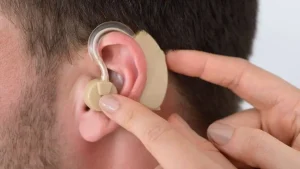
Because a hearing aid doesn’t make hearing. It takes the sound that enters your ear and amplifies it while adjusting it for clearer hearing.
If there’s nothing to turn up, it has nothing to do.
The Loudspeaker and the Broken Microphone
Picture shouting into a microphone that’s mostly smashed. A bigger speaker won’t fix it. The sound was never detected or recorded in the first place.
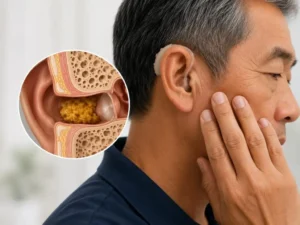
Your inner ear works a bit like that microphone. It’s full of tiny hair cells that convert vibration into nerve signals. In profound loss, most of them are gone. From that point, it can take one of two different paths:
A few surviving hair cells usually have access to a properly programmed hearing aid in at least one occasion of five which are provided to you by noise alarms and provide access to you you would otherwise lose nothing will respond or support for rear nerve cells damage is formed in greater quantities than it ever comes.
What Will You Actually Hear with a Hearing Aid?
Let’s be straight about this, because disappointment is the biggest problem we see. A person with profound loss using powerful aids might:
- Notice that someone is talking, and pick up the rhythm and loudness of speech
- Hear a door slam, a horn, the doorbell
- Follow conversation better when they can also see the speaker’s face
What they probably won’t get is clear, easy understanding in a noisy room or on a phone call. Hearing aids help you communicate. They don’t give you your old ears back.
Five Different Situations, Five Different Answers
1. A little hearing is still there.
A high-power hearing aid is worth a proper trial. Even partial sound helps with safety and lip-reading, and it matters a lot for a child learning to speak.
2. Hearing aids were fitted properly, both ears, and barely helped.
This is when we start talking about a cochlear implant evaluation. An implant skips the damaged hair cells and sends electrical signals straight to the hearing nerve.
3.The problem is nerve cells .
In the case of auditory neuropathy, the ear can feel the sound, but the signal reaching the brain is deformed or distorted. Hearing aids (high hearing) can be helpful for some people, but not for others, so you should get your examination from a specialist before choosing any tool.
4. Only one ear is deaf.
The stronger ear is handling most of the listening work. A CROS system or a bone-conduction device can pick up sound on the deaf side and pass it across.
5. The loss is conductive.
If the problem is in the outer or middle ear (such as wax, fluid accumulation or any other medical condition), the appropriate instruments can help convey sound to the inner ear; in some cases, support may also be possible through treatment or surgical (surgery).
Only testing tells this apart from nerve loss.
One or two sentences from your audiologist about a real type of case you commonly see in Lahore.
The tests that settle it
“I can’t hear anything” isn’t something a clinic should accept at face value. We can measure it.
- Pure tone audiometry finds the quietest sound you can detect at each pitch.
- ABR records how the brain responds to sound. You don’t have to press anything, so it works for babies.
- ASSR estimates your thresholds at several pitches and can catch responses a standard ABR might miss at high levels.
- OAE checks whether the cochlea’s hair cells are reacting.
- Aided speech testing shows how much you really understand with hearing aids on. For implant decisions, this one often counts most.
More on what each involves is on our hearing tests page.
Why timing matters, especially with kids?
In the early years of life, a child’s brain develops the ability to process sounds and turn them into language. Wait and hope, and you may spend months you can’t get back.
In Pakistan, deafness present from birth is a big part of childhood hearing loss.
A review of the cochlear implant programme in Lahore found that most of the implanted children were born deaf, and many of them had parents who were blood relatives. If deafness runs in your family, get your child tested early.
Don’t wait for a missed milestone. Our pediatric hearing loss lists the warning signs in babies and toddlers.
Adults shouldn’t sit on it either. The brain remembers sound for a while, and results tend to be better when the silence hasn’t lasted years.
When a hearing aid isn’t enough?
Here’s the simple dividing line.
A hearing aid needs some working hearing to amplify. An implant doesn’t depend on that, because it sends signals straight to the hearing nerve instead. Which one makes sense for you comes down to your test results, your age, your health and how much support you’ll have afterwards.
We’ve kept the full details (how implants work, who qualifies, what the process and costs look like) on our cochlear implant, so we won’t repeat them here.
Myths we hear a lot
“A stronger hearing aid will work for anyone.” Power only helps if there’s something to amplify.
“If hearing aids fail, nothing else will work.” Not true. Implants, bone-conduction devices and CROS systems exist for exactly these cases.
“Hearing aids will damage what hearing I have left.” Properly fitted ones have safe output limits, and your audiologist sets them.
“An implant gives normal hearing.” It gives a different, electrically produced kind of sound. People learn to read it over time.
What to do next?
Just a quick screening.
- Ask directly: Are there any outstanding questions, and on what pitches?
- If yours needs it, try high power hearing aids and give them a fair trial.
- Write direct messages for the aided speech test that give you an idea of how well you are seen while wearing your phone devices.
- If benefits are limited, discuss cochlear implant’s candidacy early, and tell you about the follow-up.
- Safe plan: The devices work together with the listening machine, telling the speech and excellent family and support.
FAQs
Can a completely deaf person hear with hearing aids?
Only if some hearing remains. With no response at all, a hearing aid has nothing to build sound from.
Is profound hearing loss the same as total deafness?
No. Profound means very little is left. Total means nothing is detectable. Testing tells them apart.
What happens if these devices do not work?
A cochlear implant is the primary option for both ears. Bone-conduction systems are suitable solutions in cases of deafness.
Can children with severe hearing loss use these devices?
Timely medical intervention is crucial for children with hearing loss, and determining the right option—such as an implant—is a key step in this process.
Talk to someone who can test it
If someone told you “hearing aids won’t work” without running proper tests, it’s worth a second look. The RCHI team offers hearing aid consultations, complete diagnostic testing and cochlear implant guidance at our Lahore clinic.